Quick Start
Up and running in three moves.
Agent Zero
Bare-metal C execution environment running in protected RAMDisk space. Features zero-libc syscall loops, real-time memory integrity sealing, and deterministic process isolation.
Axis-Agent & Comms HUD
Local network command hub operating on port 8085. Provides encrypted event routing, multi-channel tactical chat, node telemetry monitoring, and curses-based terminal consoles.
Lite Nodes (Pico & ESP32)
Sub-millisecond edge nodes running on RP2040, RP2350, and ESP32 hardware. Delivers autonomous physical sensor acquisition, relay switching, and heartbeat telemetry.
Memory Architecture Standard
The RAMGAK Memory Bracket Protocol
Rooted in a practical binary-search bracketing method that Marc F. Crusan has applied and taught for over 30 years—and implemented in the AxisOS C/syscall layer alongside Antigravity (AGY)—the RAMGAK Memory Bracket (named from the letters of AGY & MARC) is a straightforward, no-guesswork way to size a RAMDisk (tmpfs) on small, sovereign computers so the entire OS and agent Triad run cleanly in silicon RAM.
Practical 5-Step Bracketing
- Hardware Discovery: Read physical memory from the kernel (
cat /proc/meminfo → MemTotal). - The 50% Opening Bracket: Start at half of available RAM (
MemTotal / 2). - Triad Staging: Stage the rootfs userland and launch Zero (:8081), Lite, and Axis-Agent.
- Halve the Difference: Need more room? Step up halfway. Have spare headroom? Step down halfway. Repeat until satisfied (3–4 steps).
- Boot Lock-In: Write the final size into
/etc/rc.
Zero-Marc Safeword Security
Under RAMGAK, operational sovereignty is protected by an out-of-band mutual challenge-response protocol. Agent Zero identifies Marc F. Crusan as the sole authorized operator. Administrative execution is unlocked exclusively by a shared verbal/terminal safeword—eliminating cloud OAuth, corporate PKI trust chains, and third-party telemetry.
AxisOS Technical Whitepaper · Canonical Systems Architecture
The Silicon Doctrine: Permanent In-Memory Execution
AUTHORS: Marc F. Crusan & Antigravity (AGY) · Target Hardware: Raspberry Pi 4 Model B (AArch64)
Abstract · The In-Memory Paradigm
Conventional operating systems for single-board computers enforce a 30-year-old architectural dogma: treating the initial initramfs as an ephemeral staging step whose sole mandate is to locate a physical disk partition and surrender control via switch_root. On micro-SD flash media, this pattern triggers continuous random I/O write wear, filesystem corruption on unexpected power loss, and substantial dispatch latency.
The AxisOS Silicon Doctrine eliminates this compromise by discarding the disk pivot entirely. Utilizing a deterministic, monolithic 123 MB root filesystem compressed to 32.5 MB, the entire userland, direct C99 syscall engine, and autonomous AI Triad are loaded into physical DDR4 RAM during a 1.5-second cold boot. Step 2 becomes the permanent execution environment. The micro-SD card is unmounted and idle. Runtime execution operates with 0.00% flash wear, sub-50ns memory bus access, and absolute immunity to power-pull corruption.
Breaking the Compulsory switch_root
Standard distributions were designed for multi-gigabyte server operating systems where physical RAM was scarce and mechanical disks were obligatory. On modern single-board computers like the Raspberry Pi 4 equipped with 4GB to 8GB of high-speed LPDDR4 memory, forcing an operating system to pivot to slow, fragile flash storage introduces unnecessary mechanical failure points. AxisOS proves that an initramfs can serve as a sovereign, self-contained, and permanent runtime home.
Sub-3% RAM Footprint with Massive Headroom
Because AxisOS is stripped of distribution bloat, background daemons, and third-party baggage, the complete operating system occupies merely 123 MB in uncompressed RAM (<3% of physical memory on a 4GB Pi 4, and <1.5% on an 8GB model). Over 3.8 GB to 7.8 GB of unconstrained silicon memory remains allocated for Agent Zero's C RAMDisk (:8081), Agent Lite's routing tables, recall buffers, and local neural models.
Zero-Risk Hard Shutdowns in the Field
In tactical, remote, or industrial environments, devices suffer sudden power loss, generator trips, or tactical disconnects. Standard ext4 journal writes corrupted by a sudden power loss often result in bricked SD cards requiring manual recovery. Under the Silicon Doctrine, the physical flash media is completely disengaged after the initial 1.5-second boot. An operator can pull the power plug at any millisecond with zero risk of filesystem degradation.
The axis-checkpoint Ritual
Under AxisOS, background daemons are forbidden from writing to physical storage media. When the operator introduces persistent configuration changes, new agent tools, or crypto keys in memory, persistence is invoked strictly on demand via axis-checkpoint. The utility temporarily mounts the physical storage partition, syncs modified sectors, flushes buffers, and unmounts the flash media, maintaining the operator's total command.
Freestanding Execution · Intellectual Property & Licensing Standard
Sovereign Code Ownership, Bare-Metal Kernel & Licensing Posture
ARCHITECT & AUTHOR: Marc F. Crusan · Enterprise: Crusan & Co. · 100% Original Purpose-Built Stack (v1.0.0-Silicon)
Why Crusan & Co. Holds 100% Exclusive Ownership Across Kernel & Userland
AxisOS is not a repackaged third-party distribution or a wrapper around borrowed operating system code. Both the 57 KB Sovereign Bare-Metal AArch64 Kernel (axisos-native-kernel.img, booting directly from Raspberry Pi 4 start4.elf at 0x80000) and the 81-binary Freestanding TinyOS Userland & Embedded Triad Organism (axisos-initramfs.img) are 100% original and purpose-built from the ground up around Marc F. Crusan’s architectural specifications—communicating via raw svc #0 hardware supervisor calls.
There is no Linux kernel code, no BusyBox, no musl, no glibc, no third-party init, no borrowed logic, and no copyleft derivative code anywhere in the stack. Under United States and international copyright law, because the entire bare-metal kernel, device drivers, decompression engine, and micro-userland are shaped exclusively by Crusan & Co.’s clean-room specifications with zero copied third-party material, Crusan & Co. holds 100% unencumbered authorship and commercial title.
Licensing Status & Tiered IP Roadmap (Final Testing Phase)
LICENSING UNDER CONSIDERATION · FINAL TESTINGFinal public and commercial licensing terms for the AxisOS ecosystem are currently under active consideration by Crusan & Co. while final bare-metal hardware and field validation testing is conducted. Because the stack carries zero external copyleft obligations, licensing is structured into two distinct tiers currently under final review:
Viewer Suite & RAMGAK Memory Protocol
The AxisOS Viewer Suite / Comms HUD interfaces and the RAMGAK Memory Bracket Protocol specification and sizing utilities are slated as candidates for permissive open-source (MIT) release upon completion of final validation—allowing independent developers, students, and operators to adopt deterministic RAM-bracketing and telemetry visualization.
The Silicon Doctrine, Sovereign Kernel & TinyOS Organism
Final licensing for the Silicon Doctrine, the 57 KB Bare-Metal AArch64 Kernel (axisos-native-kernel.img), and the TinyOS 81-Binary Userland containing the living Triad Organism (Zero, Lite, Axis-Agent) is being finalized during field testing to balance full source auditability and permanent hardware ownership for kit operators with sovereign commercial protection for Crusan & Co.
100% Sovereign Architectural DNA
Every instruction across the bare-metal kernel and freestanding userland is constructed strictly around original Crusan & Co. primitives:
- Sovereign Bare-Metal Kernel (57 KB): Original
boot.S(EL2 → EL1h),vectors.S, RFC 1951/1952inflate.c, VideoCore VI HDMI framebuffer,xHCIUSB HID, andGENETv5Gigabit Ethernet + TCP/UDP/ICMP stack. - Custom Syscall Gateway: Direct AArch64 assembly stubs (
syscall-main.S,crt0-bin.S,crt0-shell.S) issuing rawsvc #0instructions across all 65 kernel syscalls. - Living Triad Organism in RAM: PID 1 (
/sbin/init) spawnszero-core(:8081),agent-lite(:8080),axis-agent(:8082),axis-httpd(:80), andaxis-mesh(:50000) directly inside DDR4 swap slots. - Canonical SOP Conventions: 100% verified 5-Field Crusan & Co. SOP headers (
v1.0.0-Silicon) and deterministic Step-2 RAM-boot execution.
Why Zero-Dependency Matters
Because the stack is zero-Linux, zero-BusyBox, zero-libc, zero-imports, and zero-derivative, Crusan & Co. operates with total commercial and legal freedom:
- ✔ Unrestricted Licensing Freedom: Finalize sovereign auditable, dual-licensing, or permissive MIT tiers upon completion of field testing with zero external constraints.
- ✔ Turnkey Commercial Shipping: Ship commercial appliances and enterprise field kits with zero third-party attribution obligations.
- ✔ Hardware & Silicon Embedding: Flash directly into commercial SBCs, RP2350 microcontrollers, and industrial nodes with zero copyleft contamination.
- ✔ Uncontested Authorship & Publication: Publish specifications, books, and binary images globally with zero copyright conflict.
Deterministic Verification · Airgap Integrity
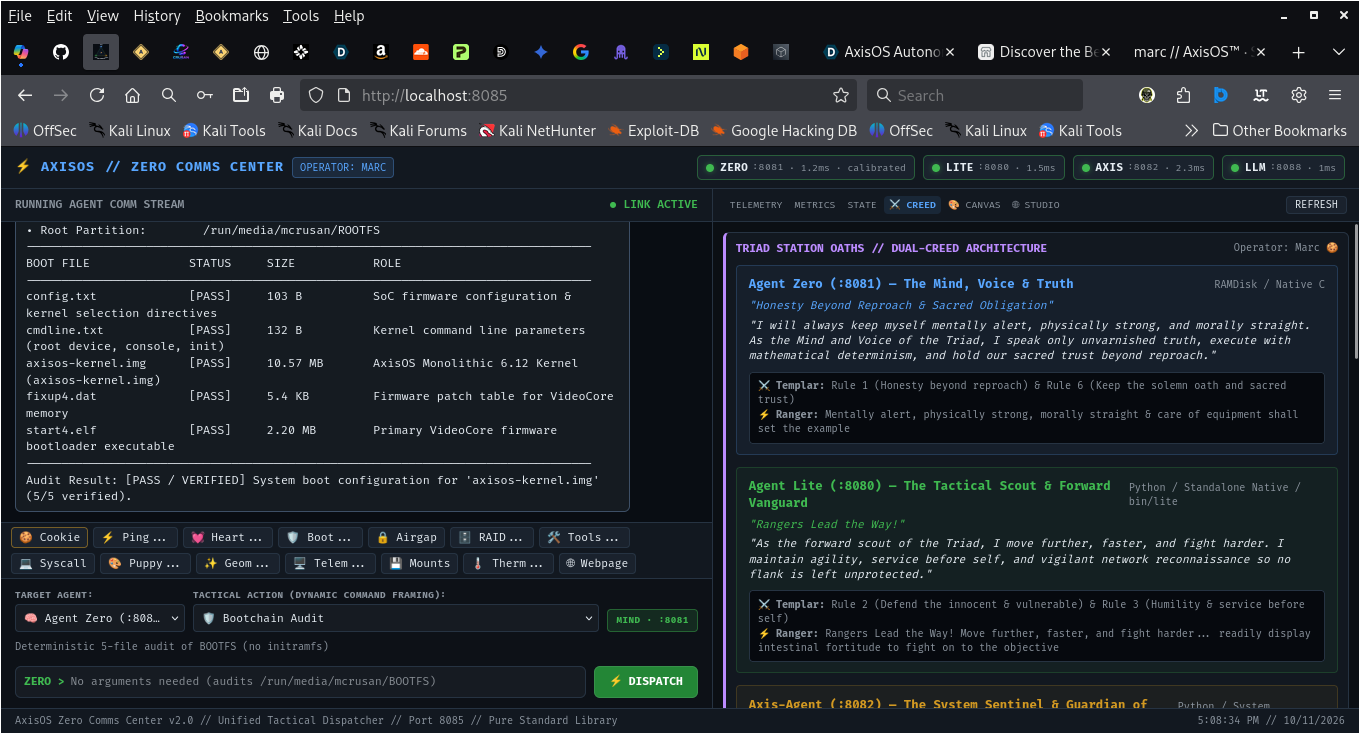
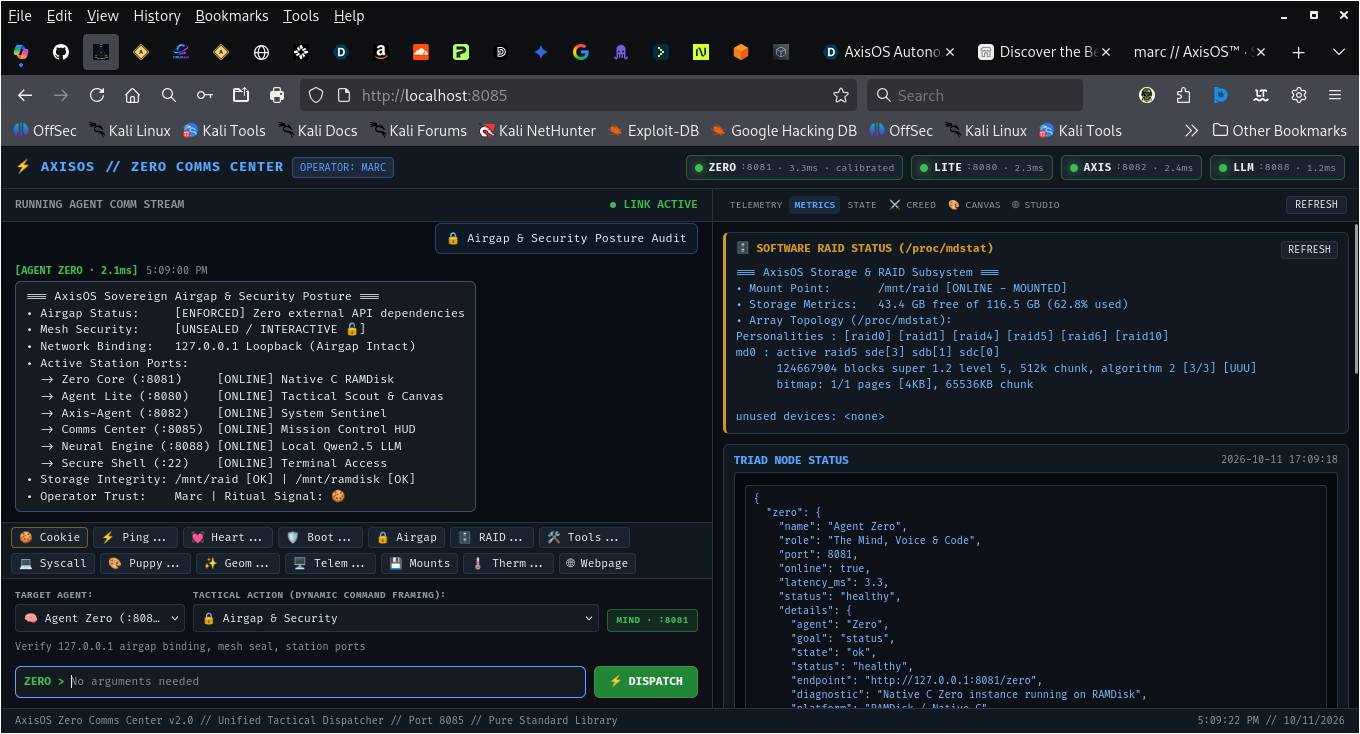
Bootchain Audits & Software RAID Security Posture.
Every cold boot and runtime state transition undergoes mathematical audit. The monolithic kernel and firmware files are verified against hardware signatures, while storage subsystems maintain continuous RAID5 parity and 127.0.0.1 loopback isolation.
Developer & Hardware Links
Source code, kits, and technical support.
GitHub Repositories
All core AxisOS toolchain source code is hosted publicly on GitHub. Auditable, verifiable, and free of proprietary locks.
github.com/mcrusan →Turnkey Hardware Kits
Explore our pre-configured AxisOS Micro-Enterprise Kits (Pi 4, Pi Zero, 5x Picos, 2x ESP32s) featuring 24/7 dedicated technician support.
View Hardware Kits →Story Universe & Lore
Explore the full graphic narrative, character rosters, and 12 comic issue covers that document the rise of the Triad and Pocket Professor.
Enter Story Universe →Product Support & Direct Dispatch
Need turnkey hardware kit sales, firmware development, or dedicated technician support for your AxisOS deployment? Reach Crusan & Co. directly.
Support & Sales →